0086 574 87739122


 Di: Ethan
Packaging materials / cup systems
Polylactic acid cups are not a universal substitute for plastic or paper. They are a cold-chain, short-shelf-life or closed-loop tool — and they fail quickly when heat, lid fit or disposal claims are treated as details.
Conclusion first: standard PLA cups make commercial sense when the product is cold or ambient, the shelf life is short, the buyer can verify industrial composting, and the filling line has been tuned for a softer, more moisture-sensitive material. They are usually the wrong first choice for hot coffee, microwave meals, long ambient distribution or any market where the cup will be landfilled and the buyer still needs a strong end-of-life story.
PLA is a bio-based polyester made from lactic acid. It can be clear, rigid and pleasant in the hand. It can also be compostable under controlled conditions — not in a home garden by default. The distinction matters because a cup advertised as “compostable” without a recognised finished-product certificate can create procurement risk rather than environmental benefit. EN 13432 and ASTM D6400 are useful references; the exact disposal route in the destination market is the operative test.
Information to request: resin grade, heat-deflection temperature, finished-product compostability certificate, lid polymer, food-contact declaration and shelf-life data for the filled product.
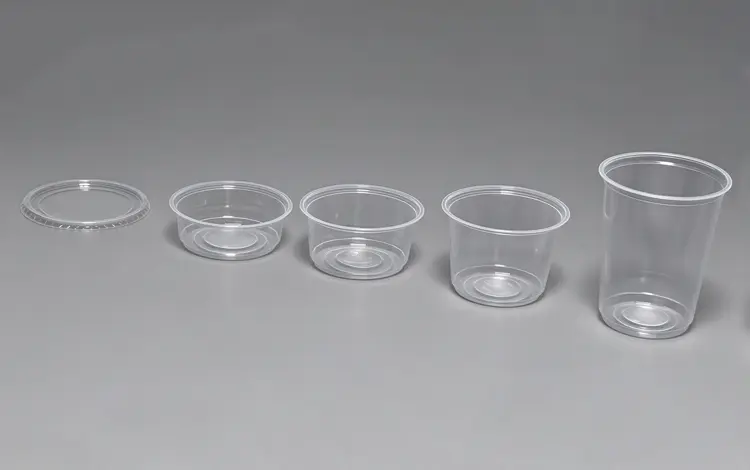
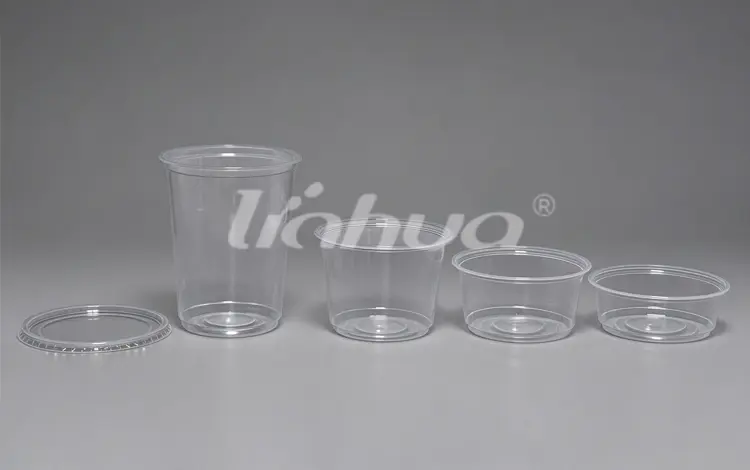 Wholesale Transparent Plastic Cups and Lids RangeCompare PP, PET, PS, TFPP and PLA cup and lid formats, sizes, rim diameters and wall thickness, with custom mould development available.View Product →
For buyers mapping formats before a trial, the cup range is a practical place to compare rim diameters, wall thickness and available sizes rather than starting from a single SKU. Linhua’s food-contact cup and lid programmes can be developed in PP, PS, PET, TFPP and PLA, with tooling and product development handled alongside production.
Standard PLA has useful stiffness and clarity, but a relatively low heat-deflection point, commonly around 50–55°C. Heat-resistant grades and crystallised PLA can lift that ceiling, but the improvement is grade-specific and should be proven on the filled cup, not assumed from a resin brochure. Moisture is the second constraint: PLA hydrolyses over time, so a humid warehouse, a wet product or a long ambient shelf life can change performance.
Wall thickness, cup geometry and the lid interface also matter more than a single resin label. A thin wall may feel elegant in a cold-drink service but collapse when the cup is carried full; a heavier wall improves rigidity but raises material cost. The relationship between wall thickness, sturdiness and insulation is covered in this note on transparent plastic cup wall thickness, and the same thinking applies when specifying PLA.
| Property | PLA | PP | PET |
|---|---|---|---|
| Heat resistance | Standard grades near 50–55°C; heat-resistant versions exist | High; often suitable for hot fill and reheating | Moderate for amorphous PET; CPET performs better |
| Moisture sensitivity | Higher; storage and product moisture need control | Low | Low to moderate |
| End-of-life | Industrial composting where certified and collected | Recycling streams vary; widely used | Established PET recycling in many markets |
| Best-fit cup uses | Cold drinks, portions, short-shelf chilled foods, closed venues | Hot drinks, robust food service, microwaveable packs | Cold cups, clear food packs, barrier structures |
The table is not a scorecard. A heat-resistant PLA grade may be fine for a warm filling line if the dwell time and lid seal are validated; a PP cup may be the better environmental choice if the local system actually recycles it.
Measure the product temperature at the nozzle, not in the tank. A 75°C sauce that cools before the lid is applied is a different risk from a 75°C beverage held in the cup. Ask for a heat-distortion test on the finished cup with the intended lid, and check whether the cup relaxes or hazes after filling.
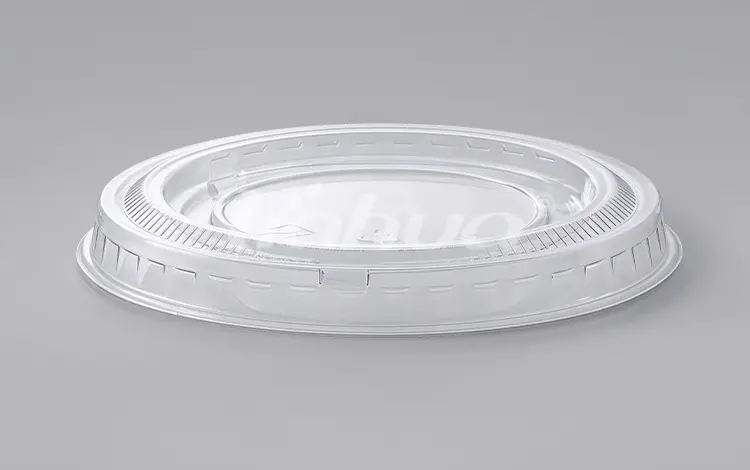
PLA cups are often paired with a lid in a different polymer. That is acceptable, but the rim geometry, taper and interference fit need to be specified together. A lid that feels tight on a PP cup can leak on a PLA cup if the rim modulus differs. For flat-lid formats, review the lid range with the cup drawing rather than ordering by nominal diameter alone.
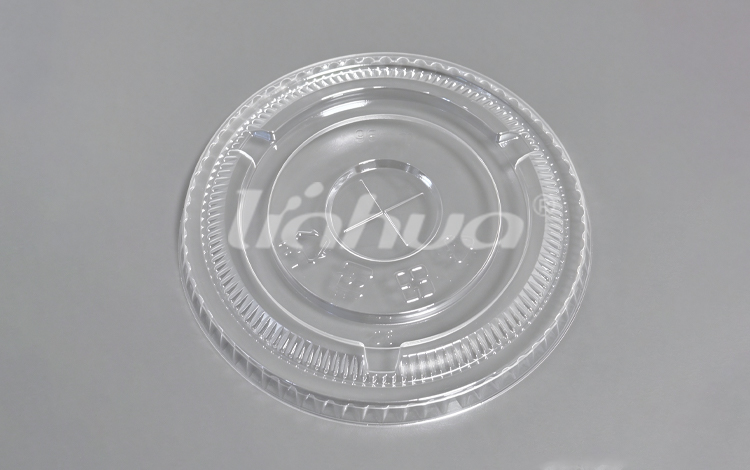 Custom PET Flat Lids for Beverage CupsPET flat sip lids for cold drinks, with a drinking spout and tight-fitting rim; specify rim geometry and fit with the cup drawing.View Product →
PLA is not a high-barrier material. For a dressing portion consumed in weeks, that may be irrelevant. For an oxygen-sensitive chilled meal, it is central. If the product needs gas barrier or a long chilled shelf, a PLA cup may still work as the outer format, but the lidding film and any barrier layer should be chosen as a system.
Compare landed cost per 1,000 saleable cups, not price per kilogram. PLA density is roughly 1.24 g/cm³, higher than PP at about 0.9 g/cm³, so a cup of the same geometry may use more material by weight. Scrap rate, line speed, lid rejects and storage humidity can erase a lower resin price quickly. A 2% reject rate on a filling line is often more expensive than a small resin premium.
That is why a sizing trial should use the intended fill volume and lid, not a water-only test. A 12oz format may be the right visual size for one drink and the wrong fill height for another once foam, ice or headspace is included.
Use PLA where the disposal route is credible and the product is forgiving. The strongest fits are cold drinks and iced coffee in closed venues, sauce and dessert portions, chilled short-shelf deli items, tasting flights and airline cold service where waste streams are controlled. The airline plastic cup discussion is a useful reminder that weight, stacking and waste handling matter as much as the resin story.
Watch the claim: “PLA” does not automatically mean “home compostable”, “marine degradable” or “recyclable”. A cup can be made of PLA and still fail a composting specification if the wall thickness, lid or print system is outside the certified scope.
A useful trial has five outcomes: fill temperature at the cup wall, lid removal force, leak performance after 24 hours, compression strength after a case stack, and a written disposal route for the destination market. Run at production line speed for at least 30 minutes. Inspect every 50th cup for rim ovality, haze, gate blush and lid fit.
A cup is not a material sample. It is a resin, a tool, a rim, a lid, a case and a disposal route acting together.
Good sign: the supplier can show the cup drawing, lid drawing, resin grade and a food-contact declaration as one package. That is more useful than a compostability logo printed on a sample.
For a quotation, send the filled product, target fill volume, fill temperature, lid type, shelf life, distribution condition, annual volume and destination market. If the brief says “PLA cup” without those details, the supplier has to guess — and guesses become line trials, not answers.
PLA cups are a sound choice for cold, short-life or closed-loop cup programmes where industrial composting is real and the lid system is validated. They are a poor fit for hot fill, long ambient shelf life or markets without collection, unless the buyer is prepared to treat the cup as a functional package rather than an environmental claim. The buying decision should rest on four numbers: fill temperature, shelf life, landed cost per 1,000 saleable cups, and the percentage of cups that actually reach the stated disposal route.
For a confidential review, share the product and line details with a packaging partner that can work across PLA, PP, PET and barrier formats. The right answer is often a mixed programme: PLA where it performs, and a proven material where it does not.
Packaging materials / cup systems PLA Cups Work Only When the Whole Packaging Line Works Polylacti...
IMBALLAGGIO DEL SERVIZIO RISTORAZIONE/NOTE APPLICATIVE Mini Antipasti in Bicchier...

0086 574 87739122
Copyright © Ningbo Linhua Plastic Co., Ltd. All Rights Reserved.


Pubblica commento